Showing posts with label Review. Show all posts

Tuesday, 9 April 2019

Saga Age of Magic Review

Updating a firmly established ruleset can be fraught with difficulties. At the club many of us have pretty much abandoned X-Wing, Kings of War and Bolt Action after they jumped to v.2. It's difficult because often a group of people will invest in the same game, but when the game has a major version change not everybody may be prepared to upgrade. So there can be quite a bit of fragmentation amongst the available players.

Studio Tomahawk's SAGA v.1 was a game that was very widely adopted at the club. Almost everybody had it and the game was a firm favourite being played on a very regular basis.


And then came v.2. A few of us upgraded quickly, but a few folks didn't see the need. Fragmentation. Personally I believe the v.2 rules do improve on the original ruleset and help to iron out some of the inconsistencies that can affect any game. I've bought the new Viking supplement and have the upgrade pack for Aetius and Arthur (now called Age of Invasions). I won't be re-buying Crescent and Cross (Age of Crusades) though.


One of the big selling points of SAGA v.2 was the promise of different Universes. The existing supplements represent three such Universes. Games are intended to be played within a Universe. It is possible to play between Universes (e.g. Vikings against Picts), but Studio Tomahawk has warned that such games may not be balanced and there may be unexpected interactions between abilities and battle boards.

The fact that different Universes are contained in their own books also means that there can be a single rulebook for the whole game that won't become out of date as new Universes are published.


Studio Tomahawk has also released a scenario book (Book of Battles) that provides a range of generic scenarios that can be played across different Universes. Both the SAGA rulebook and Book of Battles are paperback and relatively inexpensive. Universe books are hardback and cost quite a bit more (AoM is approx. £30 at the time of writing).


Age of Magic (AoM) is a new Universe for SAGA v.2. The book isn't yet widely available but can be pre-ordered at Gripping Beast. I was lucky to collect mine at Salute on Saturday.
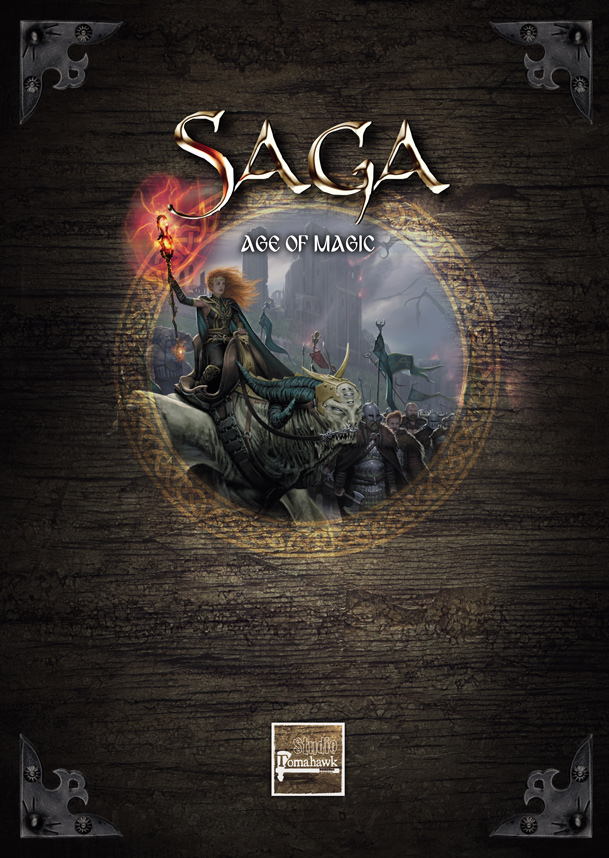


Each Universe book follows a similar design and they are all very nicely illustrated throughout with high quality photos of various figures and terrain. The AoM is a little different in that it introduces some significant changes to the basic rules and these will require a little explanation.


The basic premise of AoM is to allow SAGA to be used in a Fantasy setting. To be honest some battle board abilities in the more historical Universes can already be somewhat fantastical, but that's a discussion for another day! Of course, fantasy SAGA probably means that we will also see SciFi SAGA at some point as well. Who knows, we may also get a Pulp SAGA.

But rather than limit players to specific traditional fantasy factions (e.g. dwarves or elves), AoM has generic factions that can be used to suit the warband that you wish to field. There are six different factions: The Great Kingdoms, The Lords of the Wild, The Undead Legions, The Horde, The Otherworld and The Masters of the Undereath.

If you wish to play a warband that is composed of vampires and skeletons, then The Undead Legions is an obvious faction to use. But what about say dwarves. Well, you could decide to base these around The Great Kingdoms where their cultural and technological abilities may be the main flavour of the faction. Or you could choose The Masters of the Underearth with abilities that focus on a life lived underground. Really, the choice is yours and this makes the AoM very appealing.

It's also worth stating that Studio Tomahawk encourage the use of any figures that you have in your collection. There will not be an 'official' range that you need to stick to in order for your warband to be 'legal' with respect to the rules. Companies will no doubt start releasing figures for AoM, indeed Gripping Beast have already released undead miniatures for The Undead Legions, but you don't have to use them. I'm sure I'll end up buying new figures, but I have a mountain of zombies and skeletons from my days playing Warhammer and I've already started putting together a standard eight point warband.


This warband includes the following units:
Necromancer (Warlord)
8 Hearthguard (from the Oldhammer Nightmare Legion boxset) - 2pts
10 Skeleton Warriors - 1.5pts
20 Mindless - 1pt
2 Giant Bats (flyers) - 1pt
2 Werewolves (quadrupeds) - 1pt
1 Skull Thrower (static War Machine) - purchased by discarding 4 warriors


Eight points? Well, the new rules introduce new troop types and magic. Both of which require points to be spent, so a slight increase in the basic six point game is needed.

As well as the now familiar hearthguard, warriors and levy; AoM introduces Sorcerers, Lieutenants, Creatures, Monsters and War Machines.

Lieutenants are hero characters (similar to the warlord) that have their own characteristics and also a faction specific special rule. For example in The Undead Legions, the lieutenant is a Black Knight that can take a fatigue instead of another hero. So if the warlord used resilience to cancel a wound, the fatigue could instead be put on the Black Knight. Lieutenants are not purchased using points. Instead they are 'purchased' by discarding either 1 Creature, 2 Hearthguard, 4 Warriors or 6 Levy. Lieutenants may also be mounted. Details are provided in a handy table that is specific to each Faction.

Creatures represent figures that are generally larger and more imposing than a normal human, but still able to follow orders. This latter point is important as we shall see later. It basically means that they can take advantage of advanced Saga abilities on the battle board. Creatures are formed into units of 2 to 6 figures and can be either Bipeds, Quadrupeds or Flyers. Seasoned SAGA players will remember that a point buys either 4 hearthguard, 8 warriors or 12 levy. In AoM a point can also buy 2 creatures. So each Creature is effectively worth half a point. But there's more. An extra creature can also be purchased by discarding half a point's worth of other figures: either 2 hearthguard, 4 warriors or 6 levy. But there is an important restriction here that is tucked away in a box on page 15 of the book.

"it is forbidden to recruit a unit by removing a mix of several troop types"

This is an important rule to remember. If you want four Creatures in a single unit, you can only acquire them by (1) spending points, (2) discarding figures of the same type or (3) a combination of (1) and (2).

In SAGA v.2, standard troops have an exhaustion limit of three. So once a unit takes three fatigues, they must rest before the unit can be activated to Move, Shoot or Charge. But in AoM some units such as Creatures have a new rule called Imposing. This increases their exhaustion level from 3 to 4.

What would a fantasy game be without Monsters?! Well, in AoM there are three different types of Monster available: Behemoths (most aggressive), Titans (slow but better armoured) and Scourges (flyers). Each Monster forms a single unit and can be recruited by a warband for just 1 point! But not all factions are equal and the number of Monsters that can be recruited will depend on the faction that you choose to play.

So Monsters are big and tough. Behemoths have an Aggression rating of 14 (!), whilst Titans have a Resilience of 2 (meaning 2 wounds can be ignored for each fatigue taken). Like Creatures, Monsters are also Imposing meaning that they only become exhausted once they have taken four fatigues.

But, Monsters also have a new rule called Primitive. This means that they do not obey orders as well as other troop types. In game terms, a unit that is Primitive cannot use any of the advanced Saga abilities that can otherwise be used to activate a unit or enhance their melee or shooting. Monsters are tough, but they aren't overpowered and with a bit of thought, they can be overcome.

War Machines have previously made an appearance in other Universes (e.g. Age of Invasions), but in AoM there are now three different types to choose from: Static (e.g. stone thrower), Mobile (e.g. chariot) or Flying (e.g. a dwarf gyro-copter). Not all factions can recruit a War Machine and even those that do don't spend any points. At least not directly. In a similar way to Creatures, War Machines can be purchased by discarding other figures. But this time only 4 warriors or 6 levy may be discarded. As far as I can tell, this is the only way that a War Machine may be purchased.

The new troop types and different ways of purchasing them means that building an AoM war band will initially take a bit more effort than SAGA players are perhaps used to.

The final new troop is the Sorcerer. Sorcerers cost 1 point and are organised like heroes as a unit consisting of a single figure. Some Sorcerers can be mounted. But perhaps most importantly, Sorccerers can use Magic.

Studio Tomahawk has clearly put a lot of thought into the use of Magic in SAGA. There are six different realms of magic, each of which includes six different spells. Spells are fully described in The Grimoire found towards the back of the AoM book. Sorcerers from each Faction have access to two specific realms, but can only choose a maximum of three spells. Some Factions can recruit more than one Sorcerer, but if they do the same spell cannot be taken by different Sorcerers within the same warband.

Magic is handled in a way that fits in with the general feel of SAGA and introduces new dice. Like standard SAGA Dice, Magic Dice have symbols that represent common (1-3), uncommon (4-5) and rare (6). Each warband has a Magic Pool that determines the number of Magic Dice that are generated each turn. But unlike standard SAGA Dice, Magic Dice are not rolled at the start of the turn. Instead, they are rolled when-ever a Sorcerer wishes to cast a spell. Casting a spell is not an Activation, so a standard SAGA Dice isn't required to activate the Sorcerer that wishes to cast a spell.

To cast a spell, the Sorcerer rolls up to four of the available Magic Dice and consults the chosen spell. Each spell has three effects that increase in power. These are defined as Minimum, Optimum and Maximum. The most powerful effects being more difficult to achieve. For example, some effects require only a single Magic Dice with a blank symbol (meaning any die will suffice), whilst the most powerful effects may require a rare or even a rare and uncommon.

Why isn't the most powerful effect called Optimum? After all, players will want to cause as much carnage as possible. But casting spells may have unexpected results. A Sorcerer that uses the Maximum  power of a spell risks abusing his power and disappearing in a thundering detonation! A Sorcerer that does use the Maximum effect must roll 2d6 on the Abuse of Power Table. High or low scores will end badly... A player can choose how to spend their Magic Dice to avoid this unfortunate side-effect. In other words they can play it safe and select the Minimum effect, even if the Magic Dice could be used for the Maximum Effect.

Like other Universe books, AoM provides an overview of each faction. This details the troop types that are available, general rules for the faction (such as number of War Machines available etc) and Special Rules. One important Special Rule affects levy in The Undead Legions. With this faction levy are called Mindless and cost 1 point for 20 figures. The minimum size for a unit is 12 and the maximum is 24. However, unlike the levy in other Factions, undead Mindless can't be discarded to obtain other troops. Note that this latter rule is missing from the rulebook, but will be corrected in the FAQ.

All factions have a new terrain type available to them: Sacred Ground. This terrain is a small, high and impassable area that has special rules depending on the faction. For example, The Great Kingdoms Faction has a Memorial that allows the warband to re-roll (for free) a SAGA die during the Orders Phase - so long as a unit of eight or more figures is within VS and there are no enemy units within S.

Each faction also has Legendary Units and Legendary Warbands. Legendary Units are a little like the more familiar Mercenaries.  They cost a certain number of points (or require upgrade/downgrade of another unit) and have special rules associated with them. For example, The Lords of the Wild can recruit four Shapeshifters for 1 point.

The Legendary Warbands look very interesting. These represent two different variations of each faction with unique rules that define how the warband can be assembled. For example, The Horde can deploy Morrow Island. This is a warband that consists only of Monsters that includes a Monster
as a Warlord - Gulp! By discarding a Magic Die, the Monster Warlord can select other Monster units within L to temporarily remove the Primitive special rule. Nasty.

I would definitely like to see more Legendary Units and Legendary Warbands being developed. They can add new ways to play without publishing whole new factions.

Finally, there is a new Quick Reference sheet that summarises most of the new rules introduced in AoM. This doesn't replace the standard QR sheet, but will be very useful in games.

There are no new scenarios in AoM. Since we have the Book of Battles this isn't really unexpected, but some fantasy scenarios that make the most of the setting would have been fun. There are also no War Banners or Relics & Artifacts. Both are included in the Vikings Universe and would have been great additions to AoM. Perhaps they proved too difficult to balance.

So there we have it. AoM looks like a great addition to SAGA and will I'm sure encourage more folks to finally make the jump to SAGA v.2. Very much looking forwards to getting my first game in!


Sunday, 17 April 2016

SAGA Age of the Wolf - Review

I've now read through the new campaign supplement for SAGA and thought I'd offer a quick review and some first impressions.


I really like this! It's very obvious that an awful lot of thought has gone into creating the campaign system. I believe the supplement was probably written before Crescent and the Cross (C&C) and this does have a few implications though.
Of course, Age of the Wolf (AoW) is specifically aimed at the Viking period so doesn't include C&C warbands. Indeed AoW splits warbands into Eastern and Western factions. Pagan Rus are an Eastern faction so will never meet up with the Strathclyde Welsh for example (phew!). But it also means that the C&C rules for priests and most Swords for Hire (SfH) units are not included, which is a shame. The specific way that warbands are developed means that it may be difficult to include priests. I think a workaround may be to consider priests as a hearthguard unit and introduce them using the post battle fate table. We'll see what this means later. Warlord priests would require extra tinkering to fit, but I think could be done.
The only SfH units mentioned in the supplement are the original Jarl Sigvaldi and his Jomsvikings and the Steppe Nomads. But without too much effort I believe the rules governing their inclusion as mercenaries could be expanded to other SfH units. I suspect a FAQ on priests and SfH will be asked for by players.
Ok, time for a deep breath. Here's how the campaign works.
Each warband is led by a warlord. Warlords may be motivated by land (King's Domain), wealth (Dragon's Hoard) or reputation (Skald's Song). Starting warbands begin with 2 points of each resource and may acquire (or lose!) more as the campaign progresses. I think the rules concerning these attributes should have been more explicit in how they affect warband composition. But if I have understood things correctly from the roster sheet at the back of the book: land provides levies, wealth provides warriors and reputation provides hearthguards. A starting 4 point warband selects troops using its available resources, with each resource defining the maximum number of permitted troop type. For example, a warband can start with a maximum of two points of warriors with the remaining two points chosen from either levy or hearthguards. These can of course be split into smaller units. Since during the campaign units of levy can be upgraded into warriors and warriors into hearthguard, this isn't really a constraint. The maximum number of units allowed is 12. The rules state the campaign works for warbands between 4 and 12 points, but since 12 hearthguard cost 3 points a Bróðir of Man warband could, with enough campaign seasons, potentially include 36 points of hearthguard (this would need a lot of reputation points and is a bit extreme...)
Warlord generation looks to be a lot of fun. Once their motivation has been established, warlords are randomly assigned two traits. Traits are quite varied and range from Hard Ruler to Quarrelsome. Traits give warlords unique characteristics that can help them during the campaign.
[edit: it's worth noting here that one of the traits is Devout and allows the warlord to take a priest. But this is a special AoW priest and doesn't use the same rules as those introduced in C&C. The priest cannot be killed and must remain within VS of the warlord. No SAGA dice are needed to move him. A modified Devout trait could introduce warlord priests as described in C&C, perhaps rolling to randomly determine the type of priest the warlord becomes?].
Warlords also have an additional special rule to supplement their standard Resistance, Determination, We Obey etc. Special rules are also randomly determined and appear to borrow heavily from the rules given to existing Heroes of the Viking Age (eg. 'Bravery' allows the first point of fatigue to be ignored - just like Harold Godwinson). Specific Heroes of the Viking Age such as Harold are also allowed. A table provides guidance on their inclusion and describes their preset motivations and traits.
The campaign can include two or more warbands, but the author recommends 4 to 6 as being a good size.
Campaigns are split into seasons. The rules recommend six seasons, but any number could be played. At the beginning of each campaign season, warlords decide whether they will Raid (acquire wealth), Campaign (acquire land) or Defend (acquire reputation). If raiding or campaigning, players also select who they will target. This is now where things get interesting and demonstrates the depth of thought that has gone into the system. By cross referencing each players campaign actions on a table different types of battle are generated: raids, invasions, encounters, ambushes or pitched battles. Each type of battle is accompanied by a table that includes three different scenarios.
For example if Mighty Kyle's Norse Gael decided to raid my defending Anglo Danes then the table reveals that a Raid Scenario will be played. Raid scenarios are randomly chosen from The Escort, Harry and Burn (a new scenario detailed in AoW) or Sacred Ground. Note that the scenarios are weighted, so The Escort is selected with a d6 roll of 1 - 3, while Sacred Ground would require a d6 roll of 6.
During each campaign season, warlords can also strike alliances with other warlords adding extra spice to the mix.
After each battle there will be winners and losers - and possibly dead warlords... But this is all covered by two warlord casualty tables. Basically, if you win the battle but your warlord is 'killed', then in reality he/she probably only received a wound and can continue in the campaign. A losing warlord could be killed outright (or captured). If a warlord is killed they can be replaced, perhaps by a son who starts with the Blood Feud trait against the warband that slew his father! The rules don't actually state what to do if there is a draw. I suggest players should both use the losing warband table. That should encourage players to play for a win!
Dead levy, warriors and hearthguard are dealt with a little differently. For every four men killed, only one is actually permanently removed from the warband roster. Hearthguards benefit from a resilience rule meaning the first model removed from the battle is ignored. So to permanently kill a hearthguard, the warband would have had to lose at least 2 figures in the actual played game.
Victors are awarded extra land, wealth or reputation depending on whether they campaigned, raided or defended. The winner also receives a campaign point. Needless to say, campaign points help to determine the overall winner at the end of the campaign. But beware! More powerful warlords can gain campaign points just for realising their motivations, even if they lose a battle.
A lot going on? You bet! And there is more!!
At the end of each battle, warbands can recruit fresh troops (for free). Recruited troops must be added to existing units and no unit can include more than 12 figures (standard SAGA rules). So some thought needs to be given to the initial warband composition. Powerful warlords may at this point purchase a war banner. This is added to either a unit of warriors or hearthguard and follows the standard rules for banners. Warbands may only field a single war banner.
Warlords then roll on a fate table. Low scores could result in famine (loss of land), whilst higher scores could result in reinforcements added to existing units or forming new units. Interestingly, a favourable fate roll may allow a unit of levy to be upgraded to warriors or a unit of warriors upgraded to hearthguard. The fate table may also result in acquisition of land, wealth or reputation.
[edit: one option on the fate table is to recruit d6 hearthguards. Perhaps powerful warlords could instead recruit a random priest?]
Wealth is apparently easier to gain than land. If a wealthy warlord needs more land (perhaps to help satisfy his motivation), then he can spend 2 wealth points to purchase 1 point of land.
A warband may find itself attacked by a more powerful rival. In this situation the attacking player can dictate the points being played - yikes! But all is not lost. The weaker warband can hire mercenaries (including the previously mentioned Jomsvikings and Steppe Tribes) to pad out his force. Fortunately standard mercenaries cost only 1 point of wealth, no matter how many are required. But you only get standard foot warriors. Of course, mercenaries only stick around for the game they were hired to fight in. At the end of the battle they slink off from whence they came and so aren't added to any rosters.
[edit: Jomsviking Mercanaries provide one point of troops for one extra point of wealth. I think the same rule could easily apply to other SfH units without breaking the system (eg Angry Monks)]
There are even rules to cover situations where players are unable to meet up to play a game and so hold up the campaign. Danegeld may need to be paid by the player who isn't pulling their weight and the attacker takes 1 point of either land, wealth or reputation from his snivelling victim. Harsh!
The supplement includes five new scenarios that look like they will be fun to play even outside of the campaign setting. These include Forest Road Ambush, Harry & Burn, The Burgh, Scouts and The Hazel Wands.
So some final thoughts. It looks like a slim volume and costs £15. But as the above overview perhaps suggests, there's quite a lot in there. It's a very well thought out system and (other than the stumble with the link between troop types and resources), very well written and clearly explained. Yes it sounds complicated and involved, but once players start their campaign I honestly think it will energise dark age battles.
Should it have been published before C&C? Yes. But since it hasn't I'd have preferred it if some of the extra elements (such as the full rules for priests) had been directly worked in. Priests could have easily been awarded in the fate table for example. I would have also preferred that there was more inclusion of SfH units in the mercenary section. But these are minor quibbles really and Age of the Wolf is a solid supplement to a well established and much enjoyed game.
Now go and write your own Saga!
[edit: Here's a scanned copy of the roster sheet. At some point Gripping Beast will be making this available as a download]


Thursday, 31 March 2016

Aftermath to The Raid

Using his axe to support him, Wulfestan rose to his feet. His head throbbed but looking at the broken helm at his feet he was thankful it wasn't much worse.

"Sigered!" He yelled, "What fate has befallen us?"

The Priest walked between the pews, rubbing ointment into his shoulder. Things didn't look good. The pagans had ransacked the church desecrating the holy shrine and removing everything that they considered of worth. Before him lay four bodies. As Wulfestan moved to stand beside the Priest he looked down.

"Ailred?" He gasped. "The pagans will pay for this sacrilege..."


Johan looked over his shoulder. His warband carried chests and herded both animals and slaves. Ulf the berserker looked bleary eyed and although the gash in his stomach had been sealed with a burning brand, it continued to weep and almost seemed to resemble the shape of a Christian cross.

"Best not mention it" thought Johan.

Ahead loomed the forest.

"Let's move lads!"

Kalf winced and held his hand to his ribs.

"That mail will need some attention" remarked Johan.

"Indeed!" replied the trusted veteran of old. "Do we try for the forest or skirt it's edges?"

Johan looked at the smoke rising from the distant church.

"The Saxons won't be far behind. Ox! What say you?"


Making off with the Spoils


**********

So we've played our first game of Blood Eagle! Rather than just play a single game we intend to play through the Saga suggested in the rulebook.

One game isn't enough to fully form an opinion of the rules but I thought I'd give an overview and share a few thoughts. In terms of the rule mechanics, Blood Eagle is based on the popular steam punk rules In Her Majesty's Name (IHMN). Anyone who's played INHM before will be right at home. Although I've not yet played IHMN, I do own the book so had a quick look to make a comparison. The rules are indeed very similar, word for word in places.

So how do you play? Each player creates a warband. These can be vanilla historical types (several examples are given in the rules), or they can include Heros (think Beowulf). Warbands can also be legendary - a Frost Giant army sounds like a lot of fun.

To begin with it is recommended that players stick to battles using forces made from 250 points (or Reputation Points if you are playing a campaign). Battles can include larger warbands, but I suspect things may start to get a bit unwieldy at point sizes above 400 or 500. Unlike the unit based SAGA and Lion Rampant, Blood Eagle is based on the actions of individual figures. Figures have various statistics that govern their melee abilities, shooting and speed. They also have a fate value that (as my Saxon Thegn discovered), can help them to survive battlefield injuries.

The game is broken down into a series of phases: movement, shooting and melee. Initiative is determined by a roll of a d10 to which is added the warband's highest Leadership value. The player that wins each turn's initiative makes the first move and play then alternates between players until all figures have moved. Shooting and melee are handled in the same way with the same initiative being followed.

There are some subtleties in this mechanism that only become apparent after the first play. Deciding which figure to move and how to arrange figures for shooting or melee will significantly affect success. Shooting and melee bonuses are provided by different weapons. Shooting is particularly interesting since it is heavily influenced by whether a figure has moved (both the shooter and target). Trying to move a Skirmisher and fire a sling at a running Viking (who ends up behind a hedge), just isn't going to work!

At first I was a little concerned by the mechanism for melee. The fighter with initiative rolls a d10 and adds the figure's fight bonus (if any) + any bonuses from the weapon. This is then compared to the target's armour. Armour values depend on whether the figure is wearing leather or mail, wearing a helm, carrying a shield etc. Figures with no armour have a base value of 7. If the fighter scores equal to or more than the armour, the target is hit. So no opposed die rolls (like in Frostgrave for example) and the target's melee ability doesn't influence whether the figure is successfully hit. But in truth, the mechanism in Blood Eagle is actually quite similar to SAGA (with the inclusion of initiative and a greater range of modifiers). Figures can fumble their attack by rolling a natural 1 (followed by another roll of a 1 to confirm the fumble). Figures can gain more bonuses by outnumbering a target and weaker figures can group together to 'mob' a more powerful (or better armoured) enemy. If a figure is hit, it must make a fate roll. Kyle thought this part of the game to be thrilling. Scoring the same as the figure's fate value on the roll of a d10 means the figure is knocked over. Scoring less means they are out of the game (but not necessarily dead). Although the fate value of leaders can be quite low (3+ for my Thegn), some weapons can alter this quite significantly. Being hit by a Dane axe is definitely nasty! After a couple of fights we found the system to work very well and found the whole process very fluid.

But! There are quite a few values to look up (both for weapons and armour). This game really needs a simple reference sheet and a roster for the warbands where values for armour and weapons can be written to make them clearly visible in the heat of battle.

Terrain is simply covered and categorised by type (rated as a value from 1 to 3). Initially I was a bit confused as to how terrain affects movement. Terrain doesn't affect melee and it's affect on shooting is clearly described. But movement? I had a quick scan of the forums and found a few posts from other similarly confused IHMN players. It turns out that the terrain value is simply subtracted from the figure's movement. Most human figures have a base move of 6". This can be increased by their speed value (eg. the berserker is +2) and whether they are running (another +3 for figures unencumbered by medium/heavy armour). So in open terrain a running berserker could move up to 6+2+3 = 11 inches! But in dense forest (Type 3 terrain), this would be reduced by 3". Some terrain can also be defined as impassable.

The mechanisms for moving, shooting and melee are therefore all quite straightforward (and take up only 9 pages of the 100 page rulebook). Where I think the game shines is in the way it encourages you to build a warband and create your own Saga through linked games.

Leaders can be given individual Traits that help to characterise them. For example they could have bonuses to their Leadership or be skilled in unarmed combat. Seers and Priests can be given magical powers that are defined by whether the figure is Christian or Pagan. The magical powers are are bit like how magic was portrayed by Tolkien in Lord of the Rings (the book NOT the films!). Rather subtle and based on what people in the dark ages actually believed. Although if Kyle's skald had managed to get his bolt of fire off, it would have been the talk of the town!

There are a number of scenarios detailed in the book and these can be played together to create a campaign - or to write a Saga on your blog ;-)

Scenarios range from simple raids to assassinations, rescues and the like. Really what you'd expect, but all given a suitable dark age flavour. The scenario involving Grendel looks like just the excuse needed to invest in a large model Great Hall...

Scenarios can be played in any number of Landscapes that are themselves affected by Complications. Landscapes include the typical forests, villages, henges and marshes but also include the deck of a longship - hmm! I find the inclusion of complications to be particularly interesting. Complications are 'things' that affect how the scenario is played and may be influenced by the landscape. Since it was our first game, I chose not to complicate The Raid (sorry!), but we'll definitely be building these in to future games. Example complications detailed in the rulebook include fog/mist, twilight, stormy weather - that type of thing.

For campaign play, each player starts with 400 Reputation points. From this a warband of 250 points can be created for each game in the campaign. Reputation points are lost when figures are killed (or captured) but can be gained for winning scenario objectives, killing the enemy and ransoming captives.

Figures knocked out of action during a game make an unmodified roll on their fate. Failure means death (and loss of reputation)! But a successful roll means they can return for future battles. At the end of our first game only two of my Saxon warriors remained standing. Fate rolls resulted in the deaths of my Huscarle (poor Ailred!), one warrior and two Skirmishers. Luckily my Thegn and priest survived. Since I knocked out the Viking berserker and one veteran I gained a couple of points, but overall my reputation is down to 311. Kyle's Viking Raiders managed to pass their post game fate rolls so no points were lost. For winning the game and knocking out most of my Saxons (!) his reputation increased by an impressive 30.

Things are not lost yet though. Since only 250 points can be used for each game, I can return without the loss of reputation affecting the next warband that I field. Let's hope it doesn't drop to less than 250 after the next game...

For winning the game, Kyle can choose certain advantages in the next game. Other than mocking his dad, he can choose to deploy the terrain, choose a deployment point (subject to scenario), add or remove a complication or deploy up to three non-leader figures as scouts.

Since it's the Easter holidays I'm hoping to get at least one more game in with Kyle. Now, where did I put that box of trees...


[Update: A reference sheet is now available for download]